

About Us
Soundproofing is built on a simple idea — to create quieter, more comfortable spaces. We specialize in reducing noise with proven materials and methods, so your focus stays where it matters most — not on the distractions around you.
Contact InfoContact Info
- Office No. 9 Crescent Plaza, F10 Markaz, Islamabad
- 03127703712
- soundproofingpk@gmail.com
- Week Days: 09.00 to 18.00 Sunday: Closed
Portable Soundproof Booth for Home: Complete Guide | Islamabad, Rawalpindi
Sep/26
- admin-sp
- Blog, soundproofing
- September 25, 2026
- 0 Comments
Portable Soundproof Booth for Home: Complete Guide for Recording, Calls & Music
Working, recording, teaching, podcasting, or creating content from home can become difficult when outside noise enters your space or your voice disturbs other people. Traffic, family conversations, construction, pets, appliances, and room reflections can all affect the quality of audio recordings.
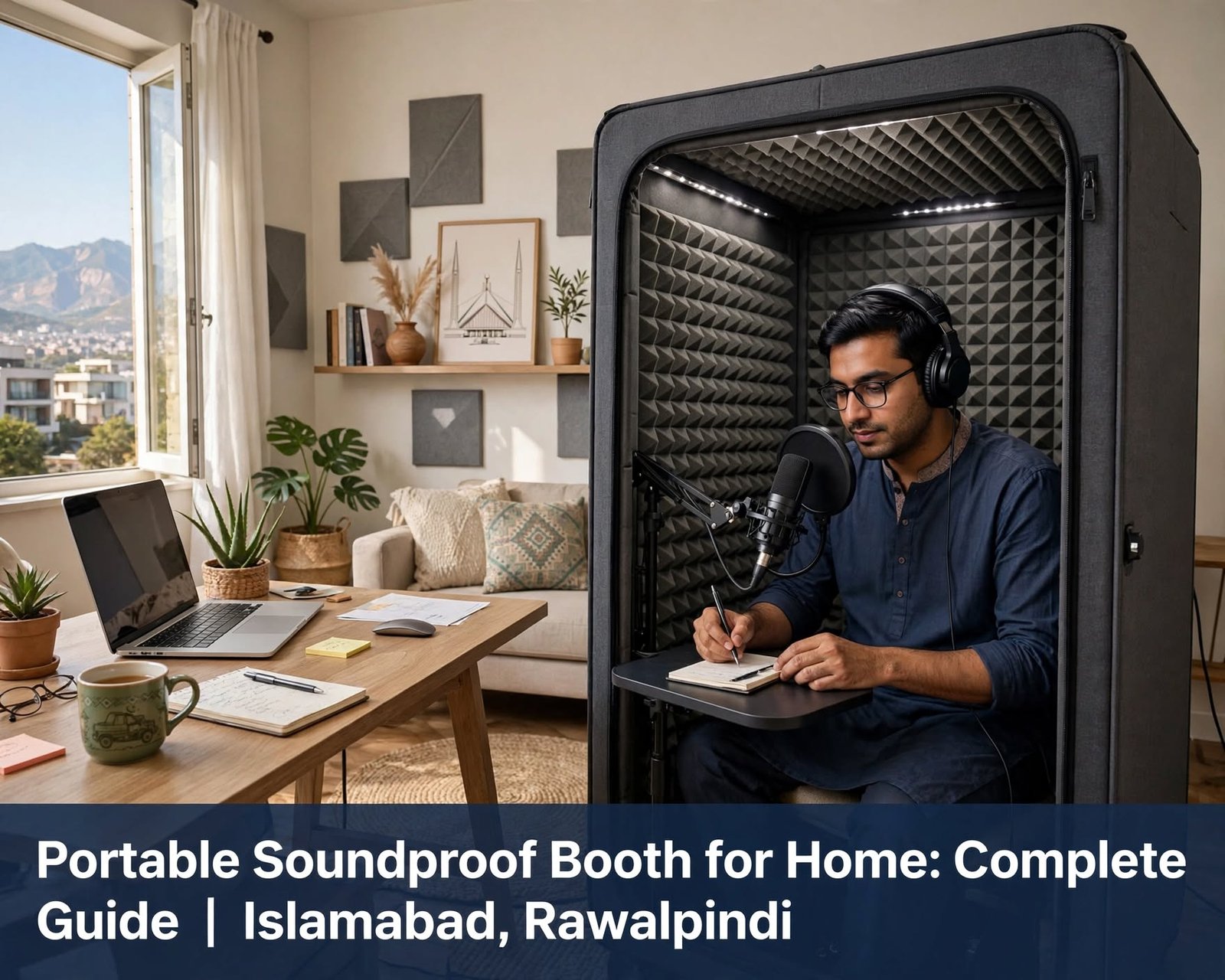
A portable soundproof booth for home can provide a more controlled environment for voice recording, podcasting, online teaching, music practice, voiceovers, and other audio-related activities without requiring a permanent studio.
Unlike a traditional soundproof room, a portable booth is designed to be compact, easier to install, and potentially movable when your workspace changes. However, choosing the right booth requires understanding the difference between soundproofing and acoustic treatment, because they solve different problems.
What Is a Portable Soundproof Booth for Home?
A portable soundproof booth is a compact enclosed space designed to reduce unwanted external noise and control the sound environment around a person or microphone.
Depending on its construction, a booth may include:
- Acoustic insulation
- Sound-absorbing panels
- Dense construction materials
- Sealed doors or openings
- Acoustic ventilation
- Internal sound treatment
- Carpet or vibration-control materials
- Microphone and equipment space
Portable booths are commonly used for voiceovers, podcasts, online meetings, music recording, singing, audiobook narration, video content, and remote work.
The level of sound isolation depends heavily on the booth’s construction, mass, sealing, ventilation, and installation quality.
Why Use a Portable Soundproof Booth at Home?
A home recording environment often has two separate problems: external noise entering the recording space and sound reflections inside the room.
A portable booth can help create a more controlled recording environment while occupying considerably less space than a dedicated studio room.
Common benefits include:
Better recording consistency: A controlled environment can make recordings more predictable.
Reduced room reflections: Sound-absorbing materials can reduce unwanted reflections and echo.
More privacy: An enclosed workspace can provide additional separation during calls and recordings.
Flexible installation: Portable solutions can be suitable for apartments, bedrooms, offices, and other limited spaces.
Space efficiency: You do not necessarily need to convert an entire room into a recording studio.
Easy relocation: Depending on the design, a portable booth can be moved or reconfigured.
Portable Soundproof Booth vs Acoustic Booth
The terms soundproof booth and acoustic booth are sometimes used interchangeably, but they are not technically identical.
Soundproofing focuses on reducing sound transmission between spaces.
Acoustic treatment focuses primarily on controlling sound reflections, reverberation, and echo within a space.
For example, acoustic foam on a wall can reduce certain reflections, but it does not automatically prevent traffic noise from entering the room.
A properly designed booth should therefore consider both sound isolation and internal acoustic treatment when the intended use requires it.
Is a Portable Booth Really Soundproof?
This is one of the most important questions to consider before purchasing or installing a booth.
A portable booth can provide significant sound isolation depending on its design, but no ordinary portable enclosure should automatically be assumed to be completely soundproof.
Sound can travel through:
- Walls
- Doors
- Windows
- Ceilings
- Floors
- Ventilation systems
- Structural connections
- Small gaps and openings
This means a booth’s real-world performance depends on its construction rather than simply the label “soundproof.”
For professional recording applications, the design should focus on mass, airtightness, decoupling, absorption, and controlled ventilation.
Best Uses for a Home Soundproof Booth
A portable booth can be useful for several home-based activities.
1. Podcast Recording
Podcasters need clean and consistent vocal recordings. A booth can reduce room reflections and help create a more controlled recording environment.
For multi-person podcasts, however, booth size and ventilation become particularly important.
2. Voiceover Recording
Voice actors and content creators often need a quiet environment with controlled acoustics.
A home voiceover booth can provide a dedicated space for recording narration, advertisements, educational content, and videos.
3. Online Meetings and Remote Work
A booth can also be useful for professionals who regularly participate in video conferences, interviews, consultations, or remote meetings.
The goal is not only to reduce external distractions but also to create clearer speech for microphones.
4. Singing and Music Recording
Musicians may use compact booths for vocal recording and selected instruments.
However, low-frequency sounds can be difficult to control in small enclosures. Professional music applications may require a more carefully engineered acoustic solution.
5. Online Teaching
Teachers, trainers, coaches, and course creators can benefit from a controlled environment when recording lessons or conducting online classes.
What Size Portable Soundproof Booth Do You Need?
The right size depends on what you intend to do inside the booth.
A small booth may be sufficient for:
- Voiceovers
- Podcasting
- Phone calls
- Online meetings
- Audiobook narration
A larger enclosure may be necessary for:
- Singing
- Musical instruments
- Extended recording sessions
- Two-person conversations
- Professional video production
Do not select a booth based only on its external dimensions. Consider the usable internal space, microphone position, ventilation, lighting, chair or stool, and equipment storage.
Important Features to Look For
If you are considering a portable soundproof booth for home, several technical features deserve attention.
Acoustic Insulation
The booth should use appropriate sound-absorbing and insulating materials to control internal reflections and reduce sound transmission.
Sealed Construction
Small gaps can significantly reduce isolation performance. Doors, joints, cable openings, and ventilation points should therefore be properly designed.
Ventilation
Ventilation is essential for any enclosed recording booth.
A booth that becomes uncomfortable or overheated after a short recording session is not practical for regular use.
Good ventilation should provide airflow while minimizing the transfer of unwanted sound.
Internal Acoustic Treatment
A booth should not simply be an empty hard enclosure. Internal surfaces need appropriate acoustic treatment to control reflections.
Lighting and Power
For content creators and professionals, integrated lighting and convenient power access can make the booth more practical.
Portability
If portability is important, consider the booth’s weight, assembly system, dimensions, and whether it can realistically be moved through doors, stairs, or elevators.
How Much Does a Portable Soundproof Booth Cost?
The price of a portable soundproof booth varies considerably depending on:
- Size
- Materials
- Construction quality
- Sound isolation requirements
- Acoustic treatment
- Ventilation
- Door design
- Customization
- Installation
- Local manufacturing or imported components
A basic acoustic enclosure may cost significantly less than a professionally engineered sound-isolation booth.
Instead of choosing purely based on price, compare the booth’s intended application, construction method, acoustic performance, durability, and ventilation system.
For professional recording, an inexpensive enclosure that does not provide adequate isolation may ultimately require additional modifications.
Can You Build a Portable Soundproof Booth at Home?
A DIY booth is possible, particularly for basic voice recording and acoustic control.
However, effective sound isolation is more complicated than attaching foam panels to a frame.
A DIY design may need to consider:
- Structural mass
- Multiple layers
- Sealed joints
- Door construction
- Floor isolation
- Ceiling isolation
- Ventilation
- Internal absorption
- Microphone placement
For serious recording work, professional design can help avoid common construction mistakes.
Portable Booth vs Soundproof Room
A portable booth and a fully soundproofed room serve different purposes.
| Feature | Portable Booth | Soundproof Room |
|---|---|---|
| Space required | Small | Larger |
| Portability | Possible | Generally permanent |
| Installation | Usually simpler | More complex |
| Cost | Varies | Usually higher |
| Suitable for home | Yes | Yes |
| Large recording setup | Limited | More flexible |
| Whole-room isolation | Limited | Possible |
| Customization | Depends on design | High |
If you only need a controlled space for one person, a booth may be more practical than converting an entire room.
If you need to isolate an entire music studio, production room, or professional recording space, full-room soundproofing may be more appropriate.
Is a Portable Soundproof Booth Good for Apartments?
Yes, a portable booth can be considered for apartments where permanent construction is difficult or not permitted.
Apartment users often have limitations involving:
- Limited floor space
- Building regulations
- Rental agreements
- Neighbors
- Noise from surrounding apartments
- Difficulty making permanent structural changes
A portable solution can provide a dedicated recording area without requiring major changes to the entire property.
However, the booth itself should be evaluated for weight, ventilation, dimensions, access, and the amount of sound isolation actually required.
How to Improve the Performance of a Home Recording Booth
Even a well-designed booth benefits from correct setup.
Position the Microphone Correctly
Microphone placement affects the amount of room sound and unwanted reflections captured by the recording.
Reduce Internal Reflections
Appropriate acoustic treatment can help control reflections from walls and other hard surfaces.
Seal Unnecessary Openings
Cable openings and gaps around doors can compromise isolation.
Control Low-Frequency Noise
Low-frequency sounds from traffic, generators, machinery, and building structures can be more difficult to control than higher-frequency noise.
Use the Right Recording Equipment
A quality microphone and suitable interface can improve recording quality, but equipment cannot compensate for a severely noisy environment.
When Should You Choose Professional Soundproofing?
A portable booth may not be enough if your goal is to create a highly isolated professional studio.
Professional soundproofing may be more suitable when you need:
- High-level noise isolation
- Music studio construction
- Podcast studio construction
- Professional voiceover recording
- Commercial recording facilities
- Home theater isolation
- Control of structural or low-frequency noise
The correct solution depends on the source of the noise, the room structure, your recording requirements, and your budget.
Portable Soundproof Booth Solutions in Islamabad and Pakistan
For homeowners, content creators, podcasters, musicians, and businesses in Pakistan, choosing a locally suitable soundproofing solution is important.
Environmental conditions, room construction, available materials, installation requirements, and the source of unwanted noise can all affect the final result.
Soundproofing.pk provides soundproofing and acoustic solutions for residential, commercial, recording, podcasting, and other specialized spaces.
If you are considering a portable soundproof booth for home, the right solution should be based on your actual use case rather than simply choosing the booth with the thickest-looking panels.
Frequently Asked Questions
What is the best portable soundproof booth for home?
The appropriate booth depends on your purpose, available space, required level of isolation, ventilation requirements, and budget. A booth designed for voiceover may not be suitable for musical instruments or high-volume recording.
Can a portable soundproof booth reduce outside noise?
A properly designed booth can reduce the amount of external noise reaching the recording space. However, the level of reduction depends on its construction, sealing, materials, and the type of noise involved.
Is acoustic foam enough to soundproof a booth?
No. Acoustic foam primarily helps control sound reflections inside a room or enclosure. Effective sound isolation requires a broader construction approach involving mass, sealing, and other soundproofing principles.
Can I use a soundproof booth for podcasting?
Yes. Portable booths can be suitable for single-person podcasting and voice recording when they provide appropriate acoustic treatment, ventilation, and enough usable space.
Can I install a portable booth in a bedroom?
Yes, depending on the booth’s size, weight, ventilation, and installation requirements. Always consider available floor space and access before installation.
Is a portable booth better than soundproofing an entire room?
Neither solution is universally suitable for every situation. A booth can be practical when only one person needs a controlled recording environment, while full-room soundproofing may be more appropriate when the entire room needs isolation.
Final Thoughts
A portable soundproof booth for home can be a practical solution for people who need a controlled environment for recording, podcasting, voiceovers, online meetings, teaching, or content creation.
The most important consideration is to understand what you actually need: sound isolation, acoustic treatment, or both. A booth should also provide sufficient ventilation, comfortable internal space, appropriate acoustic materials, and construction that matches the intended application.
If you are planning a home recording booth or need help choosing between a portable booth and complete room soundproofing, professional advice can help you select a solution based on your space and requirements.
Need a soundproofing solution for your home, podcast studio, office, or recording space? Contact Soundproofing.pk to discuss your project and get a solution designed around your acoustic requirements.
Leave a Comment