

About Us
Soundproofing is built on a simple idea — to create quieter, more comfortable spaces. We specialize in reducing noise with proven materials and methods, so your focus stays where it matters most — not on the distractions around you.
Contact InfoContact Info
- Office No. 9 Crescent Plaza, F10 Markaz, Islamabad
- 03127703712
- soundproofingpk@gmail.com
- Week Days: 09.00 to 18.00 Sunday: Closed
Home Office Soundproofing in Pakistan: Best Solutions, Materials & Costs
Sep/26
- admin-sp
- Blog, Podcast Studio Soundproofing
- September 29, 2026
- 0 Comments
Home Office Soundproofing in Pakistan: Best Solutions, Materials & Costs
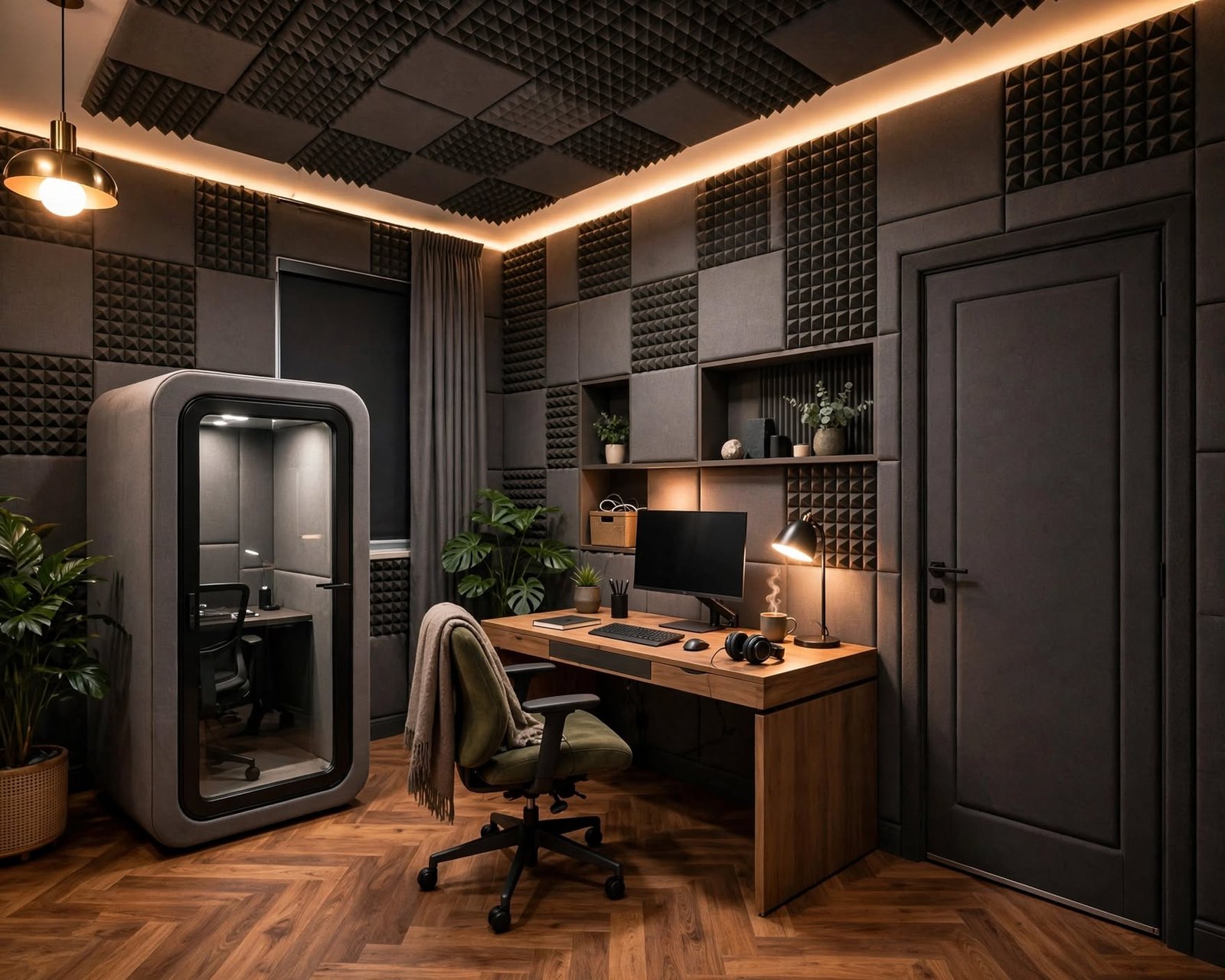
Working from home can be productive, but traffic, construction, generators, neighbors, family conversations, barking dogs, and household activity can make it difficult to concentrate or attend professional meetings. Home office soundproofing in Pakistan can help create a quieter and more private workspace by addressing the actual paths through which unwanted sound enters or leaves a room.
For freelancers, remote employees, YouTubers, online teachers, consultants, software developers, and business owners, a quiet workspace is no longer simply a comfort. Clear communication during Zoom or Google Meet calls, better concentration, improved recording quality, and greater privacy can all depend on how well the room handles sound.
However, effective soundproofing is not simply a matter of putting acoustic foam on every wall. The right solution depends on the source of the noise, the building structure, doors and windows, air gaps, walls, ceilings, and the type of sound you are trying to control.
Why Home Office Soundproofing in Pakistan Matters
Many Pakistani homes are located near busy roads, markets, schools, construction sites, commercial areas, or densely populated neighborhoods. In cities such as Islamabad, Rawalpindi, Lahore, Karachi, and Peshawar, external noise can enter through windows, doors, walls, ventilation points, and structural connections.
Pakistan’s environmental authorities have also identified traffic, construction, manufacturing, and recreational activities among sources contributing to urban noise problems.
A home office may be particularly sensitive to noise because even short interruptions can affect meetings, presentations, online classes, voice recordings, or focused computer work.
A properly planned soundproofing system can help with:
- Traffic and road noise
- Construction sounds
- Neighboring rooms
- Household conversations
- Generator and mechanical noise
- Door and window noise leakage
- Echo and excessive reverberation
- Voice privacy
- Audio and video recording quality
The objective is not necessarily to create absolute silence. Instead, the goal is to reduce unwanted sound transmission and control reflections enough to make the room more functional.
Common Noise Problems in a Pakistani Home Office
Before selecting materials, identify where the noise is coming from. Different problems require different solutions.
1. Traffic and Street Noise
If your home office faces a main road, traffic may be one of the biggest sources of disturbance. Cars, motorcycles, buses, horns, and roadside activity can enter primarily through windows and weak building openings.
A window upgrade combined with proper frame sealing can be more useful than simply installing acoustic panels inside the room.
2. Noise From Neighbors
Shared walls can transmit conversations, television sound, music, and other household activity.
In apartments or closely connected houses, treating the separating wall may be necessary. The construction method, wall thickness, cavities, and flanking paths all influence the result.
3. Family and Household Noise
A home office located next to a living room, kitchen, children’s room, or television area may receive substantial internal noise.
In this situation, the solution may involve the office door, shared wall, ceiling, or room layout rather than the exterior walls.
4. Generator and Mechanical Noise
Generators, pumps, air-conditioning equipment, exhaust systems, and other mechanical sources can create both airborne and vibration-related noise.
These situations often require a more technical assessment because simply adding decorative acoustic panels may not adequately address the source.
Soundproofing vs Acoustic Treatment: What’s the Difference?
This is one of the most important concepts for anyone planning a quiet workspace.
Soundproofing is primarily concerned with reducing sound transmission between spaces. It may involve mass, airtight construction, isolation, damping, improved doors and windows, and treatment of weak points.
Acoustic treatment is primarily concerned with controlling sound behavior inside a room. Acoustic panels can absorb reflections and reduce echo, helping speech and recordings sound clearer.
For example, if your voice sounds echoey during online meetings, acoustic treatment may help.
But if you can clearly hear traffic through a poorly sealed window, acoustic treatment alone will not solve the underlying transmission problem.
Soundproofing.pk explains the distinction between noise control and acoustic solutions across its services and product range, including acoustic panels, soundproof doors, windows, walls, and partitions.
Best Materials for a Home Office
The appropriate material depends on the noise source and the construction of the room.
Acoustic Panels
Acoustic panels are useful for controlling reflections and reverberation inside a workspace. They can make speech clearer and reduce the harsh or hollow sound often heard in empty rooms.
Soundproofing.pk offers several acoustic panel options, including fabric, polyester, microperforated, grooved, 3D polyester fiber, and art acoustic panels.
These can be particularly useful for:
- Video conferencing
- Podcasts
- Voiceovers
- Online teaching
- YouTube recording
- Professional presentations
Mass Loaded Vinyl
Mass Loaded Vinyl (MLV) is a dense material used as part of certain wall, ceiling, floor, or partition assemblies to improve sound isolation.
It is not a universal solution by itself. Its effectiveness depends on how it is incorporated into the complete construction system.
Soundproof Doors
Doors can become a weak point in an otherwise well-treated room. Gaps around the door allow sound to pass through easily.
A properly selected soundproof door system, combined with appropriate seals, can help reduce transmission through the doorway.
Soundproofing.pk lists soundproof door panels among its available solutions.
Soundproof Windows
Windows can be another major pathway for external noise.
For a home office facing a busy road, an appropriately designed soundproof window or glazing system can be an important part of the overall solution.
Wall and Partition Systems
Where noise is passing through a shared wall, a properly designed wall or partition system may be required.
Soundproofing.pk provides soundproof wall and partition solutions for spaces where separation and noise control are important.
How to Soundproof a Small Home Office
You do not always need to soundproof an entire house. A focused treatment of the workspace can be more practical.
Start with the following process:
Step 1: Identify the Main Noise Source
Spend some time inside the room and determine where the noise is strongest.
Is it coming through:
- Window?
- Door?
- Shared wall?
- Ceiling?
- Floor?
- Ventilation opening?
Finding the weakest point should come before purchasing materials.
Step 2: Seal Obvious Gaps
Small air gaps around doors and windows can provide an easy path for sound.
Check:
- Door perimeter
- Window frames
- Wall penetrations
- Cable openings
- Ventilation points
Proper sealing should be considered as part of a broader soundproofing strategy.
Step 3: Treat the Room’s Acoustics
After addressing sound transmission, consider acoustic panels or other absorptive materials to reduce internal reflections.
This is especially useful if the room will be used for calls, podcasts, webinars, or video production.
Step 4: Address the Weakest Construction Element
If noise continues after basic improvements, the issue may require wall, ceiling, window, or door treatment.
At this stage, professional assessment can prevent spending money on products that do not address the actual problem.
Home Office Soundproofing for Zoom and Online Meetings
For remote professionals, voice privacy and speech clarity are often more important than complete silence.
A good setup should address two separate problems:
External noise: Traffic, construction, neighbors, and household activity entering the room.
Internal reflections: Your voice bouncing around the room and creating echo.
For online meetings, consider combining:
- Proper door sealing
- Suitable window treatment
- Wall sound isolation where necessary
- Acoustic panels
- Soft furnishings
- Strategic furniture placement
- A quality microphone
A microphone can improve recording quality, but it cannot physically stop outside noise from entering the room. The room itself still needs appropriate acoustic treatment.
Home Office for Freelancers and Content Creators
Freelancers and content creators often need more than a quiet desk.
If you record podcasts, tutorials, voiceovers, courses, or social media videos, background noise can become part of the recording.
This is where sound isolation and acoustic treatment work together.
For example:
Traffic noise → improve the window or external sound barrier.
Neighbor noise → investigate shared-wall transmission.
Echo → install appropriate acoustic absorption.
Door leakage → improve the door and perimeter seals.
Mechanical vibration → investigate the equipment and structural transmission path.
The correct solution should be based on the specific problem rather than simply covering the room with foam.
How Much Does Home Office Soundproofing Cost in Pakistan?
There is no single price because every room and noise problem is different.
The final cost can depend on:
- Room dimensions
- Wall construction
- Number and size of windows
- Door type
- Required sound isolation
- Material selection
- Labor
- Existing building structure
- Whether walls or ceilings need modification
- Level of acoustic treatment required
Soundproofing.pk’s existing Islamabad pricing guide shows that costs can range from relatively simple door/window sealing to more comprehensive room treatments. Its published estimates are presented as market guidance rather than a fixed quotation.
For a small home office, it is usually more useful to request an assessment and quotation based on the actual room rather than relying on a generic per-square-foot figure.
DIY vs Professional Soundproofing
Some small improvements can be handled independently.
For example, you may be able to:
- Rearrange furniture
- Add curtains or rugs
- Identify obvious gaps
- Install basic acoustic treatment
- Reduce reflective surfaces
However, structural soundproofing is different.
If the problem involves shared walls, ceilings, windows, doors, vibration, or significant external noise, professional planning can help determine which construction method is appropriate.
One common mistake is assuming that acoustic foam automatically makes a room soundproof. Acoustic absorption and sound isolation serve different purposes.
Common Home Office Soundproofing Mistakes
Avoid these common mistakes when planning your workspace.
Using Acoustic Foam as the Only Solution
Foam can help with reflections but is not a complete solution for blocking substantial external noise.
Ignoring Doors and Windows
Even well-treated walls can be undermined by poorly sealed openings.
Treating Every Wall the Same
The strongest noise path should receive attention first.
Buying Materials Before Diagnosing the Problem
A product may look suitable but fail to address the actual transmission path.
Expecting Complete Silence
Soundproofing reduces transmission; it does not necessarily guarantee absolute silence.
Focusing Only on Echo
A room can have excellent acoustic treatment while still allowing substantial external noise to enter.
When Should You Hire a Professional?
Professional soundproofing is worth considering when:
- Traffic noise is severe.
- Your office shares a wall with a noisy room.
- You live in an apartment.
- You record professional audio.
- Confidential conversations take place in the room.
- Construction noise is affecting work.
- Basic sealing and acoustic treatment have not solved the problem.
- You are planning structural modifications.
Soundproofing.pk describes its process around consultation and evaluation, customized planning, and expert installation rather than using the same treatment for every space.
Home Office Soundproofing in Islamabad and Rawalpindi
For homeowners and remote workers in Islamabad and Rawalpindi, the solution should be based on the building and surrounding noise environment.
A home office near a major road may need a different approach from one affected by an adjoining apartment or upstairs footsteps.
Soundproofing.pk provides soundproofing solutions for homes, offices, studios, meeting rooms, private rooms, doors, windows, and partitions.
You can also explore the company’s broader soundproofing services when comparing solutions for a home workspace.
Frequently Asked Questions
What is the best way to soundproof a home office?
The best method depends on where the noise is entering. Doors, windows, walls, ceilings, and gaps should be assessed before selecting materials. A combination of sound isolation and acoustic treatment may be required.
Do acoustic panels make a home office soundproof?
No. Acoustic panels primarily help absorb sound reflections and reduce echo inside a room. They should not be confused with complete sound isolation.
How can I reduce traffic noise in my home office?
Start by identifying the main transmission path. Windows and gaps are common weak points. Depending on the building, improved glazing, window sealing, wall treatment, and other isolation measures may be considered.
Is soundproofing useful for Zoom meetings?
Yes. A quieter room can reduce distracting background noise and improve voice privacy. Acoustic treatment can also reduce echo and improve speech clarity.
Can I soundproof only one room?
Yes. You do not necessarily need to soundproof the entire house. A single home office can be treated according to its specific noise problems.
How much does it cost to soundproof a home office in Pakistan?
The cost depends on room size, construction, noise source, materials, doors, windows, labor, and the required level of isolation. A site assessment is more reliable than using a fixed generic price.
Is MLV enough to soundproof a room?
MLV can be one component of a sound isolation system, but its effectiveness depends on the complete wall, ceiling, floor, or partition assembly. It should not automatically be treated as a standalone solution.
Should I soundproof or acoustically treat my home office?
If your main problem is outside noise entering the room, sound isolation is important. If the problem is echo inside the room, acoustic treatment may be more relevant. Many professional workspaces require both.
Create a Quieter Workspace With the Right Solution
A productive home office does not have to be a completely silent room. What matters is controlling the noise that interferes with your work, meetings, recordings, and privacy.
The right approach begins with identifying the source of the noise and then selecting the appropriate combination of sealing, isolation, doors, windows, wall systems, and acoustic treatment.
If you are planning a dedicated workspace, recording area, or remote-working room, Soundproofing.pk can help you evaluate the space and select an appropriate soundproofing approach.
Need a quieter home office? Contact Soundproofing.pk for a professional assessment and customized soundproofing solution.
Phone: 03127703712
Email: soundproofingpk@gmail.com
Location: Office No. 9 Crescent Plaza, F10 Markaz, Islamabad.
Leave a Comment